Choosing the right lighting for a commercial or architectural project requires more than just picking a high wattage. In the modern LED era, we rely on three primary metrics to describe brightness: candela vs. lux vs. lumens. This guide breaks down each unit, explains their mathematical relationships, and provides a practical comparison to help you make an informed choice for your next lighting installation.
Table of Contents
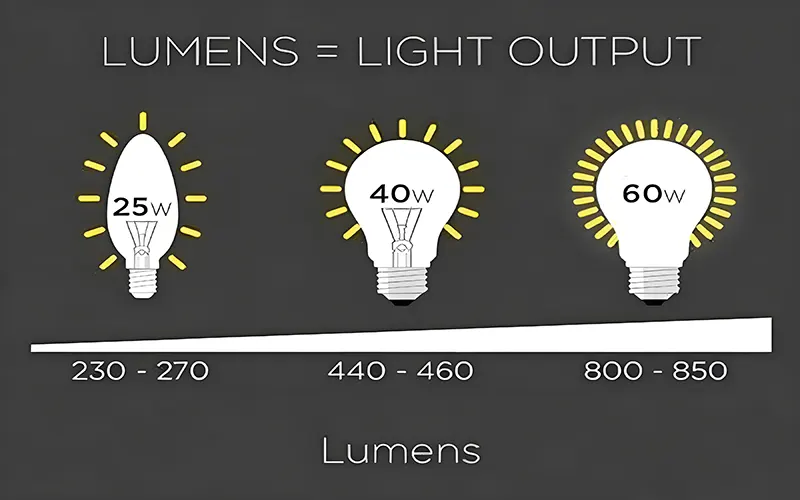
What Are Lumens?
Lumens (lm) measure the total visible light emitted by a source in all directions. It is the standard unit for “luminous flux” and has been an official SI unit since 1930.
Total Output: Lumens tell you how much light a bulb produces overall, regardless of where that light is directed.
The Obscure Test: If you cover half of a 38-lumen bulb, its lumen rating drops by 50% because the total visible light escaping the source has been reduced.
Calculation: You can calculate lumens by using a lux meter to measure light hitting a surface and multiplying that by the surface area (Lumens = Lux × Area).
What Is Lux?
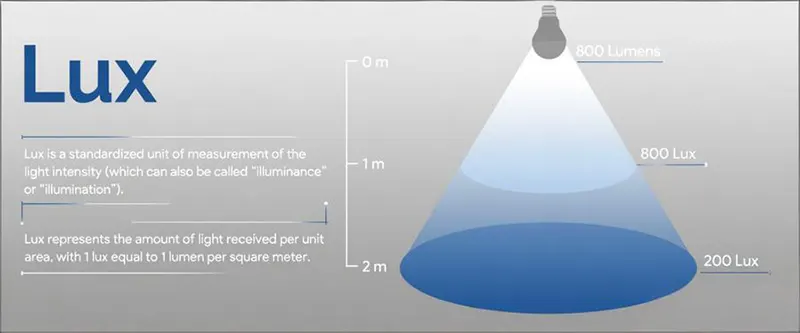
Lux (lx) measures illuminance, which is the amount of light that actually reaches and illuminates a specific surface area. One lux is equal to one lumen spread over one square meter
Surface Brightness: Lux is the essential unit for understanding how well-lit a room or outdoor space will feel once the lights are installed.
Distance Matters: Lux levels change based on how far the light source is from the surface. For example, a 500-lumen spotlight produces 500 lux on a $1\text{ m}^2$ surface, but if moved further away to cover $5\text{ m}^2$, the rating drops to 100 lux.
Real-World Examples:
- Moonlight/Twilight: ~1 lux.
- Office Lighting: 400–500 lux.
- Full Daylight: 10,000–25,000 lux.
- Direct Sunlight: Up to 100,000 lux.
What Is Candela?
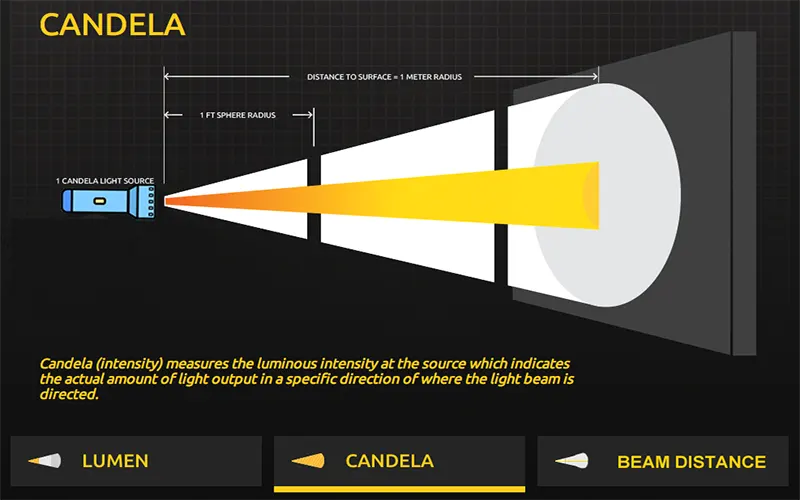
Candela (cd) measures luminous intensity, which refers to how bright a light source appears in a specific direction. While lumens look at the “total”, candela looks at the “concentration”.
- Directional Focus: High candela ratings are common in spotlights and laser pointers because they focus their light into a narrow, intense beam.
- Intensity vs. Total: Unlike lumens, if you block part of a light source, the candela rating of the remaining visible portion stays the same because the intensity of that specific direction hasn’t changed.
- Historical Context: One candela is roughly equivalent to the light output of a single candle.
- Calculation: Candela can be calculated by dividing lumens by the solid angle (steradians) over which the light is emitted.
Candela vs Lux vs Lumens: Key Differences Explained
The confusion between these terms often stems from the fact that they all measure light, but they focus on different parts of the “lighting journey” from the bulb to your eyes.
Source vs. Surface: Lumens and Candela describe the source (the bulb), while Lux describes the destination (the surface).
Quantity vs. Concentration: Lumens quantify the total light quantity, whereas Candela measures how concentrated that light is in a specific spot.
Direct Comparison: You cannot directly compare lumens to candela meaningfully; it is always better to compare two products using the same unit. For instance, a floodlight has high lumens to light a wide area, while a spotlight has high candela to direct a beam.
How Are Candela, Lux, and Lumens Related?
These three metrics are mathematically intertwined through distance and angle. Every light source contributes to all three ratings in a given space.
- The Lumen-Lux Link: Lux = Lumens / Area (m²). If you want to increase the lux on a desk, you either need a bulb with more lumens or need to move the source closer.
- The Candela-Lux Link: Lux can also be determined using the inverse square law, which states that illuminance decreases with the square of the distance from the source (Lux = Candela / Distance²).
- The Angular Factor: If light hits a surface at an angle, the lux is reduced. For example, light hitting at a 60° angle cuts the effective illuminance in half.
Quick Comparison Chart: Candela vs Lux vs Lumens
| Feature | Lumens (lm) | Lux (lx) | Candela (cd) |
| What it Measures | Total light output | Light hitting a surface | Intensity in one direction |
| Focus | Luminous Flux | Illuminance | Luminous Intensity |
| Analogy | Total flow from a showerhead | How wet the floor gets | The pressure of one water jet |
| Key Factor | The bulb’s efficiency | Distance and Area | Beam angle |
Conclusion
Mastering the differences between Lumens, Lux, and Candela is the key to moving from simple “lighting” to professional “lighting design”. To get the best results, remember: use Lumens to gauge the power of your bulb. Candela to understand its beam intensity and Lux to ensure your surfaces are bright enough for their intended use. Ready to upgrade your project lighting?
Whether you are looking for high-lumen LED strips or high-candela spotlights for architectural highlighting, our team is here to help. Contact us today for a professional lighting consultation!
FAQs
Are more lumens always better for my lighting project?
Not necessarily. While lumens measure the total light output, having too many lumens in a small space can cause glare and discomfort. For professional lighting, you must balance lumens with lux (to ensure the surface is bright enough) and candela (to control the beam’s intensity and direction).
Why does a spotlight have a higher candela rating than a floodlight?
Candela measures the intensity of light in a specific direction. Because a spotlight focuses its light into a narrow, concentrated beam, it has a high candela rating. A floodlight spreads its light over a much wider area, meaning its intensity in any single direction is lower, even if its total lumen output is high.
If I move my light further away, do the lumens change?
No. The lumen rating is the total light emitted by the source and remains constant regardless of distance. However, the lux level on the surface will decrease because the same amount of light is now spread over a larger area.
Is candela more important than lumens?
Neither is “more important”—they serve different purposes.
- Use lumens to compare total brightness
- Use candela to evaluate beam intensity and direction
Can two lights with the same lumens look different in brightness?
Yes. Beam angle, optical design, and candela all affect perceived brightness. A narrow beam of light can appear much brighter than a wide floodlight with the same lumens.