
Choosing the right LED color temperature is just as important as selecting brightness or wattage. Among the most commonly compared options, 4000K vs 6000K LED lighting often creates confusion for designers, installers, and end users.
Both are considered “white light,” but they produce very different visual effects and are used in completely different environments. Selecting the wrong one can lead to employee eye fatigue or a sterile environment that drives customers away.
Table of Contents
4000K vs 6000K LED: Key Differences Explained
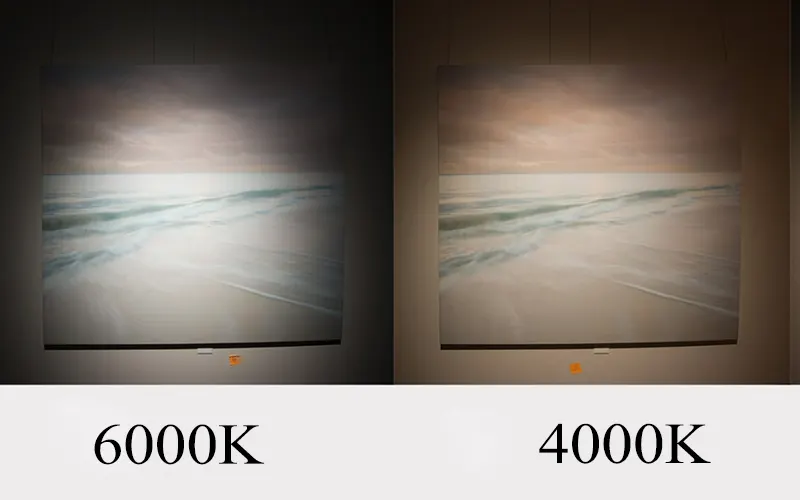
To understand the differences between these two options, it helps to understand Correlated Color Temperature (CCT). CCT is measured on the Kelvin (K) scale, which tracks the color appearance of white light from warm to cool.
4000K LED Lighting: This range is universally recognized as neutral white. It sits right in the middle of the functional lighting spectrum, providing a clean, balanced light that mimics natural afternoon daylight. It doesn’t lean too yellow (like residential 3000K warm white) or too blue, making it an excellent “work-friendly” default.
6000K LED Lighting: This range represents cool white or stark daylight-like lighting. It features a noticeable bluish tint, resulting in a crisp, ultra-sharp appearance. It mimics bright, overcast daylight and establishes a highly clinical, intense, and energetic atmosphere.
The fundamental trade-off boils down to comfort vs. extreme sharpness. A 4000K light source provides excellent visual comfort over long periods, whereas a 6000K source prioritizes high contrast and absolute visibility for precise or short-duration tasks.
4000K vs 6000K Brightness: Is Higher Kelvin Brighter?
This is the most common misconception in the lighting industry. Many users assume that a 6000K LED is automatically “stronger” or “more powerful” than a 4000K LED because the number is higher. This is false.
Kelvin (K) measures color, not brightness. Brightness is measured in Lumens (lm).
A 4000K fixture with 20,000 lumens will produce far more light than a 6000K fixture with 5,000 lumens.
However, there is a visual perception trick at play. Because 6000K light contains more blue wavelengths, which the human eye finds very stimulating, it appears brighter or more “glaring” than a softer 4000K light of the same lumen output. But if you measure them with a light meter, they would be equal.
Do not choose 6000K because you think you need more brightness. Choose based on Lumen output for intensity, and Kelvin for the quality of that brightness.
4000K LED Lighting: Features and Best Applications
4000K is the workhorse of commercial lighting. It is versatile enough for high-tech labs and welcoming enough for hotel lobbies.
Features:
Balanced Spectrum: Offers a neutral tone that renders colors accurately (especially when paired with high CRI).
Reduced Fatigue: Minimizes eye strain over long exposure periods (6-8 hours).
Clean but Comfortable: Provides a modern, clean aesthetic without the clinical “hospital” feel.
Best Applications:
- Offices (Open-plan, Private, Conference): 4000K supports “focus without excessive visual fatigue over long shifts.” It prevents the headaches and complaints associated with cooler lights in 9-to-5 environments.
- Retail Showrooms & Storefronts: It feels inviting, encouraging customers to browse and dwell longer.
- Multi-Purpose Commercial Interiors: For spaces that serve many functions throughout the day, the flexibility of 4000K prevents the space from feeling too cold or too dim.
- Healthcare (General Areas): It balances clinical visibility with patient comfort.
5. Warehouses (General circulation): 4000K is sufficient for aisles and general movement areas.
6000K LED Lighting: Features and Best Applications
While 6000K is often overused in offices (leading to high complaint rates),
Features:
High Contrast: Makes details “pop,” which is excellent for inspection.
Alertness: Mimics daylight, helping to keep workers alert.
Crisp Visual Environment:** Sharpens edges and improves depth perception.
Best Applications:
- Workshops, Garages, and Inspection Bays: “Checking surfaces, reading labels, or handling detailed assembly, 6000K provides a crisper visual environment.” The recommended range here is 5000K–6000K.
- Outdoor Perimeter & Security Zones: The stark, high-visibility appearance of 6000K is ideal for security. It ensures no shadow goes unnoticed.
- Utility Areas & Short-Occupancy Zones: If people are only in a room for 15-20 minutes (like a janitor’s closet or loading dock), the fatigue factor of 6000K is irrelevant, but the visibility is a plus.
How to Choose Between 4000K and 6000K LED Lighting?
Choosing the right CCT requires a systematic approach rather than guesswork. Use this four-step checklist to guide your next commercial project:
1. Analyze the Primary Task
What are people doing in the space? If they are sitting at computers, writing, or interacting with clients for hours, choose 4000K. If they are performing short-duration detailed assembly, material testing, or vehicle maintenance, 6000K is the right tool for the job.
2. Factor in Shift Durations
Lighting comfort plays out over hours, not minutes. A 6000K installation may look strikingly clean during a 5-minute walkthrough, but it can feel incredibly harsh by hour six of an 8-hour shift. Match 4000K to long-stay spaces and save 6000K for task-focused, shorter-occupancy functional zones.
3. Evaluate Color Accuracy (CRI)
Do not select your lights by Kelvin rating alone. You must look at the Color Rendering Index (CRI), which dictates how accurately colors appear. For general commercial areas, an industry baseline of CRI 80 is required. However, for color-critical applications like retail displays or detailed material inspection, always pair your chosen color temperature with high-CRI fixtures (CRI 90+).
4. Implement a Zoned Lighting Strategy
There is absolutely no rule stating that an entire facility must use a single color temperature. The most successful industrial and commercial designs utilize zoned lighting. Use 4000K in executive offices, employee break rooms, and reception areas, then seamlessly transition to 5000K or 6000K once you pass through the doors into manufacturing floors, utility spaces, or loading bays.
Conclusion
Ultimately, the debate between 4000K vs 6000K LED lighting isn’t about finding a “superior” light—it’s about finding the right fit for the specific function of your space. 4000K stands as the champion of day-long productivity and welcoming commercial presentation, while 6000K is an industrial powerhouse designed for high contrast and meticulous technical accuracy.
Avoid the common pitfalls of choosing based on initial impressions or assuming high Kelvin guarantees higher brightness. Instead, review your building’s tasks zone by zone, balance your Kelvin selection with proper lumen outputs and high CRI, and always request physical product samples to test in the actual environment before committing to a bulk purchase.
Contact our technical support team today for a free layout consultation. We will help you select the exact combination of lumens, CRI, and color temperatures needed to optimize your facility’s efficiency and comfort.
FAQs
Is 6000K brighter than 4000K?
Not necessarily. Brightness is measured in lumens, not Kelvin. However, 6000K light often appears brighter because cool white light is perceived as sharper and more intense by the human eye.
Which is better for home lighting: 4000K or 6000K?
For most homes, 4000K is usually the better choice because it creates a comfortable and natural atmosphere. 6000K may feel too harsh for living rooms or bedrooms but can work well in garages or workshops.
Which is better for eye strain: 4000K or 6000K?
4000K is significantly better for preventing eye strain. The high blue-light content in 6000K causes the eye to work harder to focus, leading to faster fatigue, headaches, and dryness. For any environment where people work on computers, read, or perform detailed tasks for more than 2-3 hours, 4000K is the safer, healthier choice.
Does 6000K consume more electricity than 4000K?
No. Wattage and lumens determine electricity consumption and brightness, not Kelvin. A 10-watt, 800-lumen LED can be manufactured as 3000K, 4000K, or 6000K—they will all draw the same 10 watts of power. Always compare lumens per watt (efficacy) for energy efficiency, not color temperature.
Which LED color temperature is best for offices?
4000K is one of the most popular choices for offices because it provides a clean, professional appearance without feeling overly cold or harsh.