An Outdoor LED wall washer is a linear lighting fixture designed to project broad, even light across large vertical surfaces. Unlike spotlights or floodlights that create hot spots and shadows, wall washers “wash” a facade in uniform color and brightness, highlighting architectural details while making the entire structure feel intentional and polished.
This guide explains the five most important aspects to consider when choosing an Outdoor LED Wall Washer for your architectural facade project.
Consider Beam Angle
The beam angle is arguably the most critical parameter when selecting an LED wall washer—it determines how light spreads across your wall surface and directly impacts the final visual effect. Many buyers focus solely on power and length while overlooking beam angle matching, leading to uneven illumination, dark gaps, or wasteful light overlap after installation.
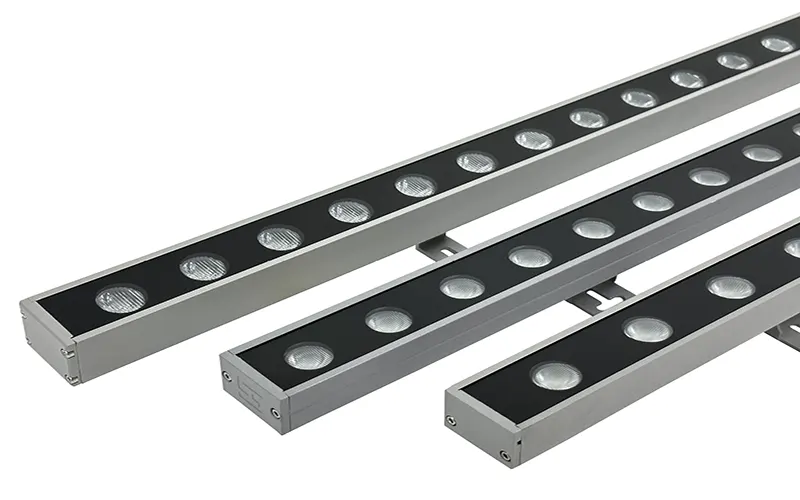
Beam angles typically range from ultra-narrow (6°–12°) to extra-wide flood (120°). Here’s how to match them to your project:
- Narrow angles (6°–24°): Ideal for high-rise buildings, distant landmark highlighting, or accenting tall columns. These beams concentrate light for long projection distances with strong visual layering.
- Medium angles (30°–45°): The most versatile choice for conventional commercial buildings, hotel facades, and villa walls between 2–8 meters in height. These strike the perfect balance between coverage and light intensity.
- Wide angles (60°–120°): Best for low walls under 3 meters, short landscape walls, or close-range broad illumination where a single fixture needs to cover large areas quickly.
For complex facades with varying heights, consider mixing multiple beam angles: use narrow beams for upper stories and wider beams for lower sections to maintain uniform coverage throughout.
Choose the Right Power and Brightness
Selecting the correct power rating is crucial—it’s not simply about choosing the highest wattage available. Overspecifying leads to unnecessary energy costs and light pollution, while underspecifying results in dim, ineffective illumination.
Practical power selection guidelines based on wall height:
- 1–3 meters : 6W–12W fixtures provide clean, delicate illumination without overpowering the space.
- 3–8 meters : 18W–24W models offer the best cost-to-performance ratio, balancing reach and coverage.
- Above 8 meters : 36W–72W high-power units ensure consistent long-distance projection and eliminate dark spots.
Beyond raw wattage, consider delivered lumens—the actual light reaching the surface after optical losses.
Select Suitable Waterproof Rating
Outdoor environments are unforgiving. Rain, dust, temperature extremes, and coastal salt spray can quickly destroy improperly protected fixtures. The Ingress Protection (IP) rating system tells you exactly how well a fixture resists these elements.
For outdoor facade applications:
- IP65 is the minimum requirement for most outdoor building exteriors. It offers complete dust protection and resistance to low-pressure water jets—sufficient for standard rain and splashing.
- IP67 is essential for coastal projects, bridge lighting, areas prone to water accumulation, or regions with heavy rainfall. These fixtures are fully sealed and can withstand temporary immersion in shallow water.
- IP68 is reserved for extreme conditions involving prolonged submersion or high-pressure washing.
Never compromise on waterproofing for outdoor installations. Products below IP65 are designed for indoor use only and will fail quickly when exposed to the elements
Pay Attention to Color Temperature and CRI
Two often-overlooked specifications—color temperature and CRI (Coloring Index)—have an outsized impact on how a facade actually looks once illuminated.
Color temperature, measured in Kelvin (K), determines whether light appears warm or cool:
- 2700K–3000K (warm white): often used for historic buildings, hotels, or residential-adjacent structures
- 4000K–6000K (neutral/cool white): common for corporate buildings, retail, and contemporary architecture
- RGB/RGBW fixtures: Enable dynamic color-changing effects for branding, events, or seasonal displays
There’s no universally “correct” color temperature—it should align with the building’s architectural style, surrounding lighting context, and brand identity.
CRI, rated on a scale of 0–100, measures how accurately a light source renders colors compared to natural daylight. For facade lighting:
- CRI 80+ is acceptable for basic illumination
- CRI 90+ is recommended when material color accuracy matters—such as showcasing natural stone, brick, or painted surfaces in their true tones
Low-CRI lighting can make facades look dull, artificially tinted, or washed out, undermining the architectural details you’re trying to highlight in the first place.
Consider Control Requirements
Modern outdoor LED wall washers offer far more than simple on/off functionality—and choosing the right control system determines how much flexibility you’ll have long-term.
Common control options include:
- Standalone/manual control: Basic on-off or preset color switching, suitable for simple, budget-conscious installations
- DMX512 control: Industry-standard protocol for precise, synchronized lighting effects across multiple fixtures—ideal for dynamic facades, light shows, or large-scale installations
- DALI or 0–10V dimming: Common in commercial building management systems, allowing integration with existing building automation
- Wireless/app-based control (RF, WiFi, Bluetooth): Increasingly popular for flexibility, allowing adjustments via smartphone or centralized software without rewiring
When planning your system, consider:
- Do you need synchronized color-changing effects, or is static lighting sufficient?
- Will the system integrate with existing building management or smart city infrastructure?
- Is scalability important (adding more fixtures or zones later)?
Summary
Selecting the right outdoor LED wall washer requires balancing multiple technical factors, each playing a critical role in the final outcome. For large or complex facades, consider working with a lighting designer who can perform photometric simulations using IES/LDT files to verify illumination levels before installation.
If you’re looking for a professional manufacturer of outdoor LED wall washer solutions, LUMMI LIGHT offers high-quality products with OEM and ODM customization, multiple beam angle options, RGB/RGBW and DMX512 control, durable waterproof construction, and expert technical support.
FAQ
What is the difference between a wall washer and a floodlight?
wall washer is designed specifically to create a smooth, even layer of light across a vertical surface. It uses asymmetric optics to distribute light uniformly from top to bottom, eliminating the harsh hotspots and deep shadows typical of floodlights.
Floodlights cast a wide, unfocused beam that scatters light in all directions—useful for general area illumination but inefficient for facade lighting. Wall washers are the preferred choice for architectural applications where visual quality matters.
How far apart should outdoor LED wall washers be spaced?
Spacing depends on beam angle and mounting distance from the wall. As a general guideline, fixture spacing should roughly match the mounting distance for narrow beam angles and can be wider for broader beam angles. A lighting designer can calculate exact spacing to avoid uneven “scalloping” effects.
Can LED wall washers change color?
Yes. RGB and RGBW wall washers can produce dynamic, full-color lighting effects, making them popular for branding, seasonal displays, and special events. Fixed color-temperature (white light) models are better suited for consistent, year-round architectural lighting.
Can LED wall washers be installed on any building material?
Yes, but beam angle and brightness may need to be adjusted based on the surface. Textured materials like brick or stone often benefit from grazing light angles, while reflective materials like glass may require different placement to avoid glare.
What IP rating do I need for outdoor facade lighting?
IP65 or IP66 is recommended for most architectural facade applications.