Facade lighting design can turn an ordinary building into a nighttime landmark — or leave a beautiful piece of architecture invisible after dark. The difference rarely comes down to the fixtures alone. It comes down to the decisions made long before installation begins: what to light, how bright it should be, what color temperature fits the mood, and how the design will hold up against glare, energy costs, and the surrounding environment.
This guide walks you through twelve critical factors that shape a successful facade lighting design—from defining your objectives and understanding your environment to managing budgets, selecting fixtures, and implementing smart controls. Get these elements right, and your building will stand out for all the right reasons.
1. What Do You Want to Light?
Start by identifying what actually deserves attention: the main entrance, structural columns, a distinctive roofline, decorative detailing, or a textured material like stone or brick that comes alive under grazing light. Lighting everything equally tends to flatten a building’s character. Choosing a few key features instead gives the facade depth, hierarchy, and a clear identity once the sun goes down.
2. How Do You Want It to Look?
Once you have identified what to light, the next question is how you want it to appear. This is where you define the design intent, which will govern every subsequent decision from fixture selection to control systems.
Consider the mood you wish to create. Do you want the building to feel:
- Inviting and warm – Welcoming visitors with soft, gentle illumination
- Dramatic and atmospheric – Using bold contrast and accent lighting for impact
- Dynamic and energetic – Incorporating colour changes or movement for entertainment districts
- Refined and understated – Suitable for corporate headquarters or heritage buildings
The building type also influences this decision. A shopping mall or entertainment plaza might benefit from extravagant, colourful lighting, while a bank or corporate headquarters typically achieves landmark status through restrained, elegant illumination. A hotel might balance warmth at the entrance with subtle highlighting of architectural features.
3. Analyze the Environmental Context
The surrounding environment shapes what a facade lighting design needs to accomplish. Workplaces and public buildings generally prioritize safety and clear visibility, so functional lighting that supports security and wayfinding should top the list.
Retail and exhibition spaces work differently — they’re built around the product and the viewer’s experience. A storefront, for example, might use focused accent lighting to spotlight window displays and draw pedestrians inside. Residential and hospitality settings are more personal still, calling for warmer, softer lighting that creates comfort and relaxation rather than drama.
4. Budget and Cost Planning
Budget constraints are a reality for every project, but addressing them early prevents disappointment and enables creative solutions. Taking a seat and counting the cost before selecting a design ensures you do not reach the halfway point only to discover expenses have spiralled beyond control.
Key budget considerations:
- Initial capital costs – Fixtures, cabling, control systems, and installation labour
- Ongoing operational costs – Energy consumption and maintenance requirements
- Replacement cycles – LED fixtures have long lifespans, but eventually require replacement
- Future upgrades – Leaving capacity for control system enhancements
Remember that the cheapest solution upfront rarely proves the most cost-effective in the long run. Investing in quality fixtures and intelligent control systems typically delivers superior performance and lower operational costs over the building’s lifespan.
5. Select the Appropriate Beam Angle
Beam angle determines how light spreads across a surface, and it’s one of the most overlooked technical decisions in facade lighting. A narrow beam concentrates light for dramatic, focused highlights — ideal for columns, sculptures, or architectural details. A wider beam spreads light more evenly, better suited to washing large, flat surfaces.
Choosing the wrong beam angle is a common cause of uneven lighting: hot spots where the beam is too narrow, or a washed-out, flat look where it’s too wide. Matching beam angle to the specific surface and mounting distance is essential to getting a clean, consistent result.
6. Determine the Ideal Brightness Level
Getting the brightness right is a careful balance between visibility, impact, and comfort. Too bright and you create glare and visual discomfort; too dim and the building disappears into the background.
Factors influencing ideal brightness:
- Surface reflectance – Dark materials absorb light and require higher output; light materials reflect more and need less
- Distance from fixture – Brightness diminishes with distance—mount fixtures closer for lower output requirements
- Background ambient light – Urban environments with high ambient lighting require brighter facades to stand out
- Purpose of lighting – Wayfinding and security require different levels than purely decorative illumination
7. Select the Right Light Fixtures
With your objectives, beam angle, and brightness determined, the next step is selecting fixtures that can deliver your vision. Different luminaires create different results, so matching the tool to your goal matters enormously.
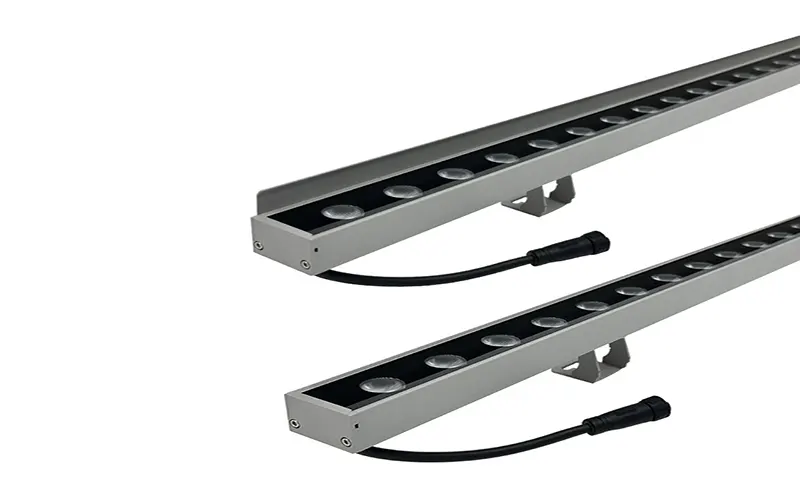
Common facade lighting fixtures:
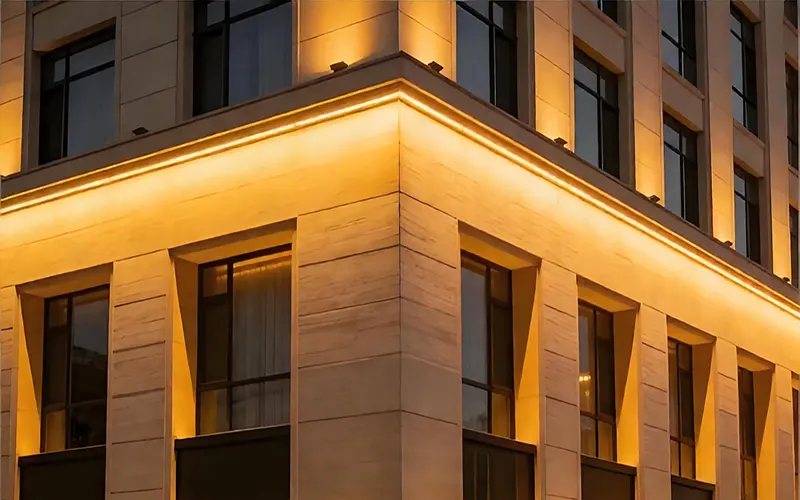
- Linear lights (wall grazers) – Mounted close to the wall, these reveal texture on stone, brick, or concrete surfaces. Excellent for creating dramatic shadow patterns.
- Wall washers – Positioned slightly away from the surface, these spread even, glare-free light across flat facades. Ideal for smooth, modern buildings.
- Floodlights – Placed farther back from the building, these cover large or tall surfaces with broad illumination. Versatile and effective for many applications.
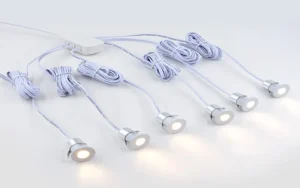
- Spotlights – Using narrow beams, these highlight specific architectural features like columns, entrances, or sculptures with precision.
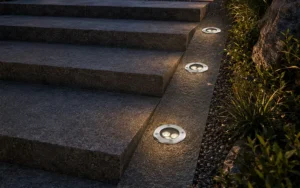
- In-ground uplights – Recessed at the base of the wall, these emphasise height while remaining virtually invisible during the day.
- RGBW linear bars or pixel lights – Controlled by DMX systems, these enable dynamic or colour-changing effects for entertainment districts or special occasions.
Essential technical specifications:
- IP rating – Always select IP65 or higher for outdoor use to withstand weather conditions
- Beam angle – Ensure the fixture’s beam angle matches your requirements
- Colour temperature – Verify the fixture delivers the colour temperature you want
- Lumen output – Confirm the fixture provides sufficient light output for your application
Never select fixtures based solely on aesthetics or price. The technical specifications determine whether the fixture actually delivers the effect you planned.
8. Choose the Correct Color Temperature
Light color falls on a spectrum from cool (more blue) to warm (more yellow), and each end suits different environments and purposes. Cooler lighting tends to create a crisp, daytime-like feel, often used around open workspaces, plazas, or civic buildings, typically at higher brightness levels.
Warmer lighting, by contrast, tends to suit residential and hospitality facades best, and generally looks more natural at lower brightness levels. Mixing color temperatures inconsistently across a single facade is one of the fastest ways to make a design feel disjointed, so it’s worth settling on a coherent color strategy early.
9. Prioritise Energy Efficiency and Sustainability
Facade lighting typically runs for several hours every night, which makes energy efficiency a long-term cost — and sustainability — issue, not just an environmental one. LED fixtures remain the standard choice for facade lighting projects because they use significantly less energy than older lighting technologies while offering a longer service life.
Efficient design also means avoiding unnecessary illumination. Lighting only the features that matter, using appropriate brightness levels for the context, and pairing fixtures with smart controls all reduce energy use without compromising visual impact.
10. Implement Smart Controls and Automation
Modern lighting technology offers more control than ever, and deciding how the lights will be operated is as important as choosing the fixtures themselves. Common control options include:
- Manual switches for basic on/off control
- Timers or photocells that activate lighting automatically at dusk
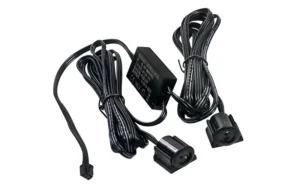
- Motion sensors that light specific zones only when needed
- App-based or centralized control systems (such as DMX) for adjusting brightness, timing, and color from one place
For larger buildings, a centralized control system is usually the most practical option. It allows scenes and schedules to be programmed and adjusted without touching individual fixtures, and it makes it far easier to keep the lighting aligned with the original design intent over time.
11. Consider Architectural Form (Solid, Perforated, Vertical, Horizontal)
Different facade types require different lighting techniques. Understanding your facade’s form and materiality ensures your lighting approach works with the architecture rather than against it.
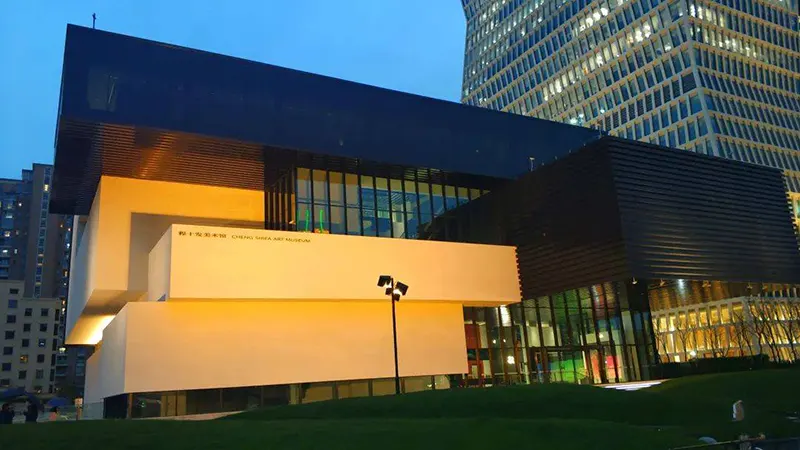
Solid facade:
Smooth, flat walls with no texture react strongly to how light hits them. Larger surfaces need careful layout to avoid hot spots or dark patches. Washing techniques work well, while grazing may reveal imperfections.
Perforated facade:
Features openings that create creative, layered lighting opportunities. Light passes through perforations, creating striking patterns visible from inside and outside. Works beautifully with both up-lighting and down-lighting.
Vertically divided facade:
Vertical lines like columns or fins demand lighting that strengthens this rhythm. Use narrow beams with up-lights and down-lights to emphasise height and verticality. Place fixtures to create consistent illumination along each vertical element.
Horizontally divided facade:
Horizontal lines cast heavy, long shadows when lit from below. Increase the luminaire offset—mount fixtures farther from the wall—to soften these shadows and achieve more uniform illumination.
Additional architectural considerations:
- Building height – Affects fixture positioning and required beam angles
- Building width – Determines how many fixtures are needed for consistent coverage
- Facade material – Reflectance and texture significantly influence lighting approach
- Position of light source – Distance from building impacts beam spread and shadow creation
Always analyse the facade’s geometry before selecting fixtures or developing your layout. The right approach for a solid concrete tower will differ significantly from that for a perforated metal screen or glass curtain wall.
12. Avoid Light Pollution & Glare
Facade lighting doesn’t exist in isolation. Poorly directed or excessively bright light can spill onto neighboring buildings, streets, and the night sky, creating light pollution that affects residents, drivers, and local ecosystems. It can also produce glare that’s uncomfortable for pedestrians and passing traffic.
Anti-glare baffles, shielded fixtures, and careful aiming all help direct light exactly where it’s needed rather than scattering it outward.
Conclusion
Effective facade lighting design is a process that demands careful consideration of many interconnected factors. From defining your objectives and understanding your environment to selecting fixtures, managing budgets, and implementing controls, every decision influences the final outcome.
At LUMMI LIGHT, we help you match custom lighting solutions to your building’s design goals. Our team of specialists can provide tailored fixture recommendations and comprehensive project quotes designed around your specific requirements.
FAQ
-
Why is facade lighting important?
It enhances aesthetics, reinforces brand identity, improves safety and security, contributes to urban character, and increases property value.
-
What IP rating do I need?
IP65 or higher for outdoor facade lighting. IP66 for exposed locations, IP67 for in-ground installations.
-
Can I retrofit existing buildings?
Yes, but consider power availability, cable routing, mounting options, and planning permissions (especially for heritage buildings).
-
Why is my lighting patchy?
Caused by insufficient fixtures, incorrect beam angles, poor positioning, or dirty lenses. Review layout and adjust accordingly.
-
Why is there glare?
Fixtures too bright, visible light sources, or high contrast. Add anti-glare baffles, reposition, or reduce output.
-
Why are colours inconsistent?
Mixed manufacturers, different LED bin codes, or differential ageing. Specify single-source fixtures with consistent bin codes.