
Bridges are more than functional crossings — they are landmarks, safety corridors, and often the first impression a city makes after dark. Effective bridge lighting design blends engineering precision with visual artistry, ensuring drivers, cyclists, and pedestrians move safely while the structure itself becomes a nighttime showpiece.
1. Start with Safety and Visibility Requirements
Safety is the non-negotiable foundation of any bridge lighting design. Before any creative decisions are made, designers must ensure that roadways, walkways, and structural edges are clearly visible to drivers and pedestrians in all weather conditions. This means eliminating dark spots, glare, and harsh shadows that could obscure lane markings, curbs, or railings.
Local and national lighting codes typically dictate minimum illumination levels for vehicular and pedestrian zones, and these standards should be treated as a starting point, not a ceiling. Consider how lighting performs during rain, fog, or snow, since reduced visibility conditions amplify the risk of accidents. A well-lit bridge should feel consistently safe from one end to the other, without abrupt gaps or blinding hotspots.
2. Understand the Bridge Structure and Architectural Features
Every bridge has a unique structural identity — suspension cables, trusses, arches, pylons, or box girders — and the lighting design should respond directly to that geometry. A cable-stayed bridge, for example, offers dramatic opportunities to highlight converging lines, while a stone arch bridge may call for softer, more historic-feeling illumination that respects its masonry texture.
Study the bridge’s engineering drawings and materials before finalizing a design. Reflective or textured surfaces behave differently under light than matte or smooth ones, and structural elements like expansion joints or maintenance walkways may restrict where fixtures can be mounted. Understanding load-bearing capacities is also essential, since some lighting equipment requires additional structural support. Ultimately, the lighting should enhance the bridge’s inherent character rather than fight against it, drawing the eye toward its most distinctive architectural features.
3. Determine the Required Light Levels and Distribution
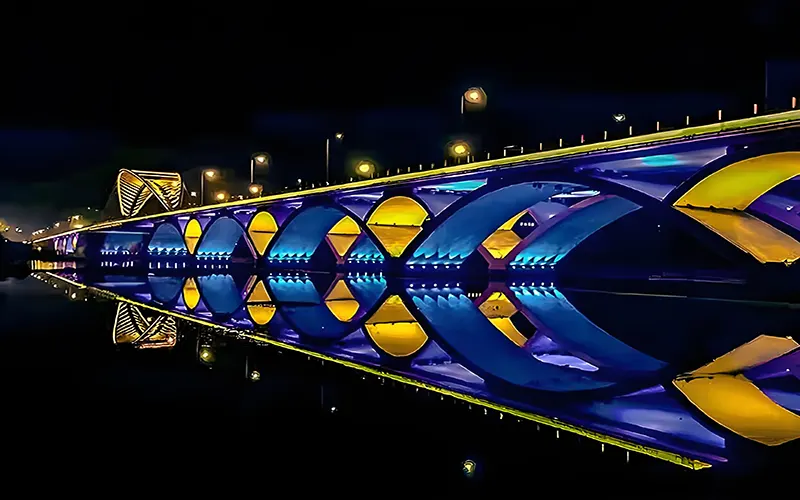
Once safety codes and structural characteristics are understood, designers must calculate precise light levels for each functional zone. Roadways typically require higher, uniform illumination for fast-moving traffic, while pedestrian and cyclist paths may need different lux levels tailored to slower speeds and closer sightlines.
Light distribution is just as important as intensity. Poorly distributed lighting can create pooling effects — bright patches followed by dim gaps — that strain the eyes and reduce overall safety. Photometric modeling software is commonly used to simulate how light will spread across the bridge deck, towers, and surrounding water or landscape before installation begins. This modeling helps designers fine-tune fixture spacing, mounting height, and beam angles to achieve smooth, even coverage. Getting the distribution right the first time also saves high costs, since retrofitting lighting on a bridge is far more expensive than adjusting a design on paper.
4. Plan Fixture Placement and Installation Locations
Where fixtures are physically mounted has a major impact on both performance and maintenance. Common placement options include under-deck mounting, railing-integrated fixtures, tower-mounted floodlights, and in-ground uplights along approach roads. Each location comes with trade-offs in terms of visibility, glare control, and accessibility for future servicing.
Designers should map out sightlines from multiple vantage points—driver eye level, pedestrian eye level, and views from the surrounding city or waterfront—to ensure fixtures illuminate the bridge without creating distracting glare for any group. Placement also needs to account for wind loads, vibration from traffic, and potential water exposure, especially for fixtures near the underside of the deck. Planning access points for bulb replacement, cleaning, and repairs early in the design process prevents costly complications once the bridge is in service.
5. Choose Durable Lighting Fixtures for Harsh Outdoor Conditions
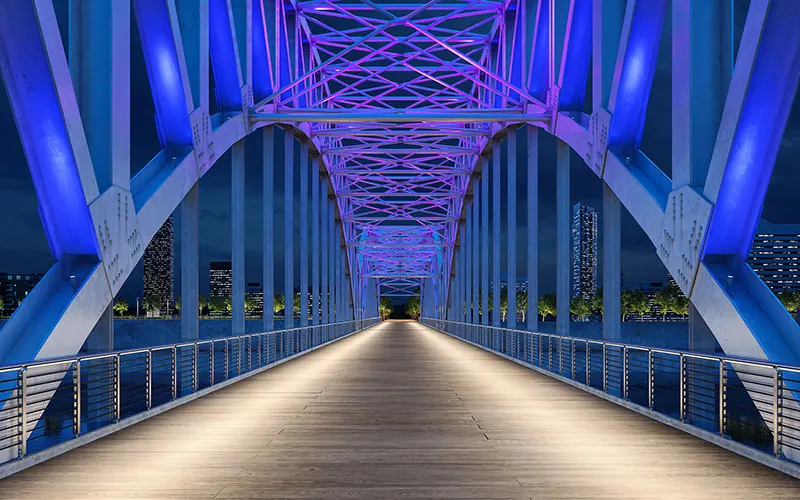
Bridges endure extreme conditions: constant vibration from traffic, high winds, humidity, salt spray, and dramatic temperature swings. Standard indoor lighting won’t survive here. You need fixtures built to withstand these stresses. Look for products with high Ingress Protection (IP) ratings—IP65 or IP66 are recommended for resistance to water, mist, and dust.
Beyond IP ratings, consider these quality standards:
- 3-G Vibration Rated: Withstands heavy bridge vibrations and stress.
- IK08 and IK10 Rated: European standards (equivalent to IEC 62262) that certify resistance to external mechanical impacts.
- MIL-STD 810G Rated: A military standard for shock, impact, and extreme temperature resilience.
Durable fixtures reduce long-term costs, minimize downtime, and ensure your bridge stays beautifully lit for years to come.
6. Select the Right Bridge Lighting Fixtures
Different bridge elements require different types of lighting fixtures. There is no single fixture that works perfectly for every application.
Common options include:
LED Flood Lights: Suitable for illuminating large structural surfaces, towers, pylons, and areas beneath bridges.
LED Wall Washers: Useful for creating an even layer of light across architectural surfaces and emphasizing the bridge’s form.
LED Linear Lights: Ideal for highlighting straight or curved structural lines, railings, edges, and beams.
LED Strip Lights and Neon Flex: Useful for decorative outlining and continuous illumination along architectural contours.
LED Underground Lights: Can provide uplighting for columns, towers, arches, or other structures from ground-level positions.
LED Handrail and Step Lights: Suitable for pedestrian bridges where functional visibility and subtle architectural lighting are both required.
The final selection should consider beam angle, wattage, color temperature, CRI, IP rating, mounting method, control compatibility, and expected operating life.
7. Consider Energy Efficiency and Environmental Impact
Bridge lighting can operate for many hours every night, so energy consumption should be considered during the design stage.
LED technology is generally well suited to bridge projects because modern LED fixtures can provide high light output with relatively low power consumption and long service life.
Energy efficiency can be improved further by:
- Selecting the appropriate wattage
- Avoiding unnecessary over-lighting
- Using efficient optical systems
- Dimming fixtures during low-traffic periods
- Scheduling lighting according to actual usage
- Using smart lighting controls
- Designing precise beam distribution to minimize spill light
Environmental impact should also be considered. Poorly designed bridge lighting can create excessive skyglow or disturb nearby wildlife and aquatic environments.
Using shields, precise optics, lower light levels, and carefully controlled operating schedules can help minimize unnecessary light pollution.
8. Create an Attractive Lighting Design with Color and Effects
A successful bridge lighting design balances utility with artistry. Honoring the bridge’s surrounding culture, history, and architectural heritage can transform an ordinary transit structure into an iconic tourist destination.
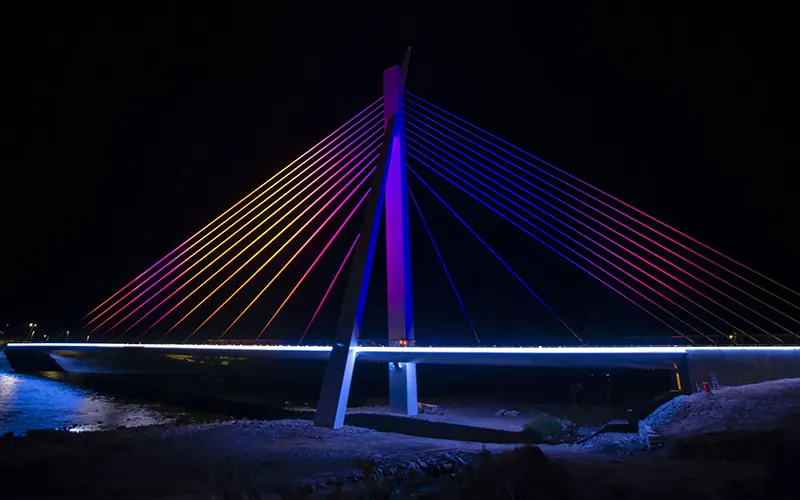
Using a mix of color temperatures, static architectural lighting, and dynamic color-changing RGBW fixtures allows designers to craft customized displays for holidays, local festivals, and special events. Retrofitting retro-styled fixture housings with modern LED engines provides the perfect balance between historical charm and modern performance.
9. Integrate Smart Lighting Controls for Long-Term Flexibility
A modern bridge lighting system should ideally be designed with future control requirements in mind.
Depending on project complexity, lighting controls may include timers, dimming systems, sensors, DMX512, DALI, or other centralized control technologies.
Smart controls can allow operators to:
- Adjust brightness remotely
- Schedule daily operating times
- Create different lighting scenes
- Change colors for special events
- Monitor system performance
- Reduce energy consumption
- Respond quickly to maintenance issues
For large landmark bridges, individually controllable LED fixtures can create sophisticated animated effects while allowing operators to manage the entire system from a central control platform.
Planning the control system early is important because communication wiring, power distribution, controllers, and fixture compatibility all need to work together.
Popular Bridge Lighting Design Ideas
There are many ways to create an attractive bridge lighting scheme. Some popular approaches include:
Outline Lighting
Linear LED fixtures or LED neon flex can trace the edges of a bridge, emphasizing its overall silhouette.
Structural Accent Lighting
Wall washers and flood lights can highlight towers, arches, beams, and other important architectural elements.
Cable Lighting
For suspension and cable-stayed bridges, carefully positioned linear fixtures can emphasize the rhythm and geometry of cables without overpowering the structure.
Under-Bridge Lighting
Fixtures installed beneath the deck can illuminate structural elements and create reflections over nearby water.
Dynamic RGBW Lighting
RGBW systems allow the bridge to display different colors and lighting scenes for events and celebrations.
Interactive Lighting
Advanced projects can connect lighting controls with events, sensors, music, or city-wide lighting systems to create interactive experiences.
The best concept depends on the bridge’s architecture, surroundings, viewing distance, budget, and intended purpose.
Common Mistakes to Avoid in Bridge Lighting Design
Even experienced designers can fall into traps. Here are three common mistakes and how to avoid them:
- Over-reliance on Roadway Lighting Standards: Extending standard street lighting across the entire bridge can overwhelm architectural lighting and create glare. Instead, reduce the number and density of roadway lights, lower mounting heights when possible, and consider using low-level path lights or recessed LEDs that focus light directly on the pavement. This preserves the visual quality of the structure while maintaining safety.
- Overusing Dynamic Effects: While kinetic lighting is exciting, too much motion can be jarring—especially since bridges exist within dynamic environments (moving water, flowing traffic). Rapid color changes or flashing sequences can cause visual fatigue and even contribute to light pollution. Use longer cycle times and gradual fades.
- Excessive or Inappropriate Color Use: Bridges are not shopping malls. Using too many colors—or colors that clash with the bridge’s materials—can cheapen the design and create visual confusion. In navigable waters, improper colors can also interfere with shipping signals. Stick to a restrained palette that complements the structure and its surroundings.
Summary
A well-executed bridge lighting design harmonizes safety, structural engineering, environmental responsibility, and creative aesthetics. By choosing durable, energy-efficient LED luminaires rated for harsh conditions, planning intelligent fixture placement, and integrating smart control systems, you can transform a simple transportation route into an enduring community landmark.
If you are planning a bridge, landscape, or architectural lighting project, LUMMILIGHT can provide durable LED lighting solutions for demanding outdoor applications, including LED wall washers, linear lights, flood lights, underground lights, and other customized LED lighting products. Contact our team to discuss your project requirements and find a suitable lighting solution for your application.