The stability of outdoor LED lighting systems hinges on the driver. Unlike ordinary power supplies, LED drivers need to withstand extreme temperatures, humidity, and voltage fluctuations, while also ensuring the lifespan and luminous efficiency of the luminaires.
Table of Contents
What is an Outdoor LED driver?
Simply put, an LED driver is an electronic device that supplies and regulates the electrical power required by LED lighting fixtures. Unlike traditional incandescent bulbs, LEDs are low-voltage direct current (DC) devices, while the power supply in our homes and businesses is typically high-voltage alternating current (AC). The primary function of an LED driver is to convert this high-voltage AC power into the low-voltage DC power required by the LEDs. More importantly, it also stabilizes the current or voltage output to protect the LEDs from power fluctuations, ensuring stable illumination and extending their lifespan.
Do all LED lights require a driver?
The answer is: almost all LED lights require a driver, but the form may vary. For common LED light bulbs or integrated LED fixtures on the market, you might not see a separate driver, because the driver is usually built into the base of the bulb or fixture. These integrated drivers are designed to be compact, making them convenient for consumers to install and use directly.
However, for high-power, professional outdoor LED lighting systems, such as streetlights, floodlights, or landscape lighting, the driver is usually a separate component, making maintenance and replacement easier. Whether built-in or separate, the core function of the driver remains the same: to provide stable and appropriate power to ensure optimal performance and long lifespan of the LEDs.
What are the uses of LED drivers?
- Voltage/Current Conversion: Converts AC power to DC power and adjusts the voltage or current to the LED’s operating range.
- Current/Voltage Stabilization: Protects LEDs from voltage or current fluctuations. LEDs are very sensitive to excessive voltage or current; unstable power can lead to light decay, damage, or even burnout.
- Temperature Management: Some advanced drivers can monitor the LED temperature and reduce the current when overheating occurs, protecting the LED from thermal damage.
- Dimming Function: Many drivers support dimming protocols (such as 0-10V, PWM, DALI, Triac) to adjust the brightness of the lighting fixtures, meeting the lighting needs of different scenarios and energy-saving goals.
- Protection Functions: Provides short-circuit protection, overload protection, overvoltage protection, and over-temperature protection to ensure the safe operation of the lighting system.
- Improved Energy Efficiency: High-efficiency drivers minimize energy loss, converting more electrical energy into light energy, thereby reducing operating costs.
Outdoor LED Driver Types: Constant Voltage vs. Constant Current
When choosing an outdoor LED driver, the most basic classification is between constant voltage and constant current. The differences between the two are as follows:
| type | Constant voltage driver | Constant current driver |
| Output control | Fixed voltage, such as 12V or 24V. | Fixed current values, such as 350mA, 700mA, 1050mA, etc. |
| Applicable lighting fixtures | LED strip lights, modules, low-voltage landscape lights | High-power point light sources, wall washer lights, floodlights |
| Control flexibility | Easy to connect multiple light fixtures in parallel. | More precise control and better brightness consistency. |
| Common occasions | RGB LED strips, advertising signs, ambient lighting | Engineering projects, outdoor floodlighting, stage lighting |
For outdoor use, it is recommended to select a suitable type of driver according to the specifications of the lighting fixture; otherwise, it may lead to accelerated light decay or power instability. The type of driver to choose depends on the specific requirements of your LED lighting fixture.
Key Factors to Consider When Choosing Outdoor LED Drivers
Selecting the right LED driver for outdoor lighting is a decision that requires considering several factors:
Power Matching: The driver’s output power must match the total power of the connected LED fixtures. It’s generally recommended that the driver’s power be slightly higher than the total power of the LED fixtures (e.g., 80W total LED power, choose a 100W driver) to provide a margin and prevent the driver from operating at full load for extended periods, which can shorten its lifespan.
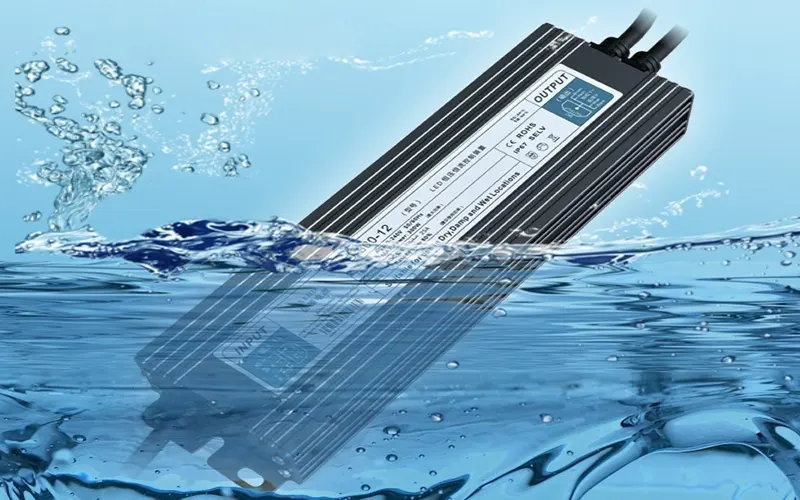
IP Rating (Ingress Protection): This is one of the most important indicators for outdoor drivers. The IP rating indicates the device’s protection against the ingress of solid particles (such as dust) and liquids (such as water).
- IP65: Dustproof and resistant to low-pressure water jets. Suitable for sheltered or general outdoor environments.
- IP67: Completely dustproof and resistant to short-term immersion in water. Suitable for environments where contact with water is possible but not prolonged immersion.
- IP68: Completely dustproof and resistant to prolonged immersion in water. Suitable for underwater lighting or extremely humid environments. Choosing a driver with an IP rating that matches the installation environment is crucial.
Operating Temperature Range: Outdoor environments experience significant temperature fluctuations, and the driver must be able to operate stably under extreme high and low temperatures. Check the driver’s datasheet to ensure its operating temperature range meets the climate conditions of your region.
Efficiency: Driver efficiency indicates how much of the input power is converted into effective output power. High-efficiency drivers (usually above 90%) mean less energy loss (heat generation), thus reducing operating costs and extending the driver’s lifespan.
Dimming Capability: If you need to adjust the lighting brightness according to different times or needs, you will need to choose a driver that supports dimming. Common dimming protocols include 0-10V, PWM (Pulse Width Modulation), DALI (Digital Addressable Lighting Interface), and Triac (Triac dimming).
Surge Protection: Outdoor environments are susceptible to surge voltages caused by lightning strikes and power grid fluctuations. Drivers with built-in surge protection or support for external surge protectors can effectively protect LED fixtures from damage. Certifications and Standards: Choose drivers that have international or regional certifications (such as UL, CE, RoHS, TUV, etc.), which indicate that the product meets strict safety, performance, and environmental standards.
Lifespan and Warranty: High-quality drivers should have a lifespan of at least 30,000 to 50,000 hours and a warranty period of at least 3 to 5 years.
Outdoor LED Driver Installation and Safety Precautions
Correct installation is crucial for ensuring the safe and efficient operation of outdoor LED lighting systems.
Power Disconnection: Always disconnect the power supply before performing any installation, wiring, or maintenance! This is the most important safety step.
Choosing the Right Location: The driver should be installed in a well-ventilated location that allows for proper heat dissipation and is away from high humidity, corrosive gases, or flammable materials. Avoid direct sunlight.
Correct Wiring: Strictly follow the wiring diagrams of the driver and LED fixtures. Ensure that the input (AC) and output (DC) terminals are connected correctly, and that the polarity is not reversed. Use the correct wire gauge (wire thickness) to avoid overheating.
Waterproofing and Moisture Protection: Even if the driver itself has a high IP rating, all connection points (such as junction boxes) should be properly waterproofed and sealed. Use waterproof connectors, potting compound, or waterproof enclosures to prevent moisture ingress.
Grounding: Ensure that the driver casing is properly grounded to prevent electrical leakage or lightning strikes.
Load Matching: Again, the driver’s output power and type (constant voltage/constant current) must perfectly match the LED fixtures.
Heat Dissipation: The driver generates heat during operation. Ensure sufficient space for heat dissipation and do not install it in a confined, airtight space.
Common Faults and Troubleshooting
- LED light not turning on: First, check if the power supply is working correctly, then check if the driver’s input and output connections are correct and secure. The problem may be a driver malfunction or a fault in the LED fixture itself.
- LED light flickering or unstable brightness: This is usually an indication of unstable driver output. Check for fluctuations in the input voltage or if the driver is overloaded. It could also be due to aging internal components in the driver.
- Part of the LED fixture not lighting up: If the LED beads are connected in series, one of the beads may be damaged, causing the entire circuit to fail. If it’s a constant voltage LED strip, the problem may be with the driver or the LED strip itself in that particular section.
- Driver overheating: Check if the installation environment is well-ventilated and if there are any obstructions hindering heat dissipation. Ensure the driver is not operating under overload conditions.
- Abnormal light color (RGB system): This could be due to signal line interference or a controller malfunction.
Summary
Simply put, outdoor LED drivers are like “bodyguards” for LED lights. They convert the 230V household electricity into a current suitable for LEDs, and also provide protection against water, lightning, and freezing temperatures, ensuring the lights operate stably and don’t fail prematurely.
Want to choose the most suitable LED driver for your outdoor lighting project? Contact our team of experts today for personalized advice and solutions.
FAQs
Do outdoor LED lights require a dedicated LED driver?
Yes, especially medium-to-high power outdoor lighting fixtures (such as floodlights, wall washers, and in-ground lights) must be used with a dedicated LED driver. It provides a stable power supply and prevents damage or failure of the lights due to unstable voltage, water ingress, etc.
Can LED drivers be installed outdoors?
Yes, but only if the driver has a high protection rating (IP65 or higher is recommended) and is installed in a well-ventilated, waterproof location.
How to determine if an LED driver is constant current or constant voltage?
Check the driver label or technical specifications: If the output is labeled “DC12V” or “DC24V,” it’s a constant voltage driver; if the output is labeled “350mA,” “700mA,” or “1050mA,” it’s a constant current driver.
Can overheating of the driver cause the LED lights to fail?
Yes. Prolonged overheating can lead to abnormal driver output, which can then damage the LED chips. Ensure proper ventilation during installation, avoid direct sunlight, and regularly check the cooling system.
Can the driver be installed underground?
Absolutely not, because the dampness of the soil can cause a short circuit.