When you need to provide ample lighting for outdoor spaces, building facades, or large areas, floodlights are the most common choice. But as LED technology continues to advance, the debate around LED floodlights vs. halogen floodlights has become increasingly relevant. Are traditional halogen floodlights still worth buying today?
This article will delve into a detailed comparison of LED floodlights vs. halogen floodlights, examining their performance, cost, and overall suitability to help you make a well-informed purchasing decision for your lighting project.
Table of Contents
What are Floodlights?
Floodlights are lighting fixtures designed to provide large-area, uniform illumination. Their purpose is to disperse light over a wide area rather than focusing it on a specific point. Unlike spotlights, floodlights typically have a beam angle of 45 degrees or more, some even reaching 120 degrees or wider, allowing them to effectively illuminate large spaces.
From a technical perspective, the core characteristic of floodlights is their optical design. Through special reflectors, lenses, or diffusers, floodlights redistribute the light emitted by the light source, creating a broad and relatively uniform light pattern. This design makes floodlights particularly suitable for areas requiring large-area illumination, such as parking lots, sports fields, building facades, courtyards, and industrial work areas.
Floodlights have an extremely wide range of applications. In residential applications, floodlights are commonly used for yard lighting, garage lighting, and security lighting, providing safety and convenience for homeowners. In commercial environments, floodlights are widely used for parking lots, commercial building exterior lighting, and billboard lighting, meeting both functional needs and enhancing visual appeal. In the industrial sector, floodlights are indispensable equipment, providing sufficient lighting for various workplaces.
Based on the light source type, floodlights are mainly divided into two categories:
- Halogen floodlights: Use halogen bulbs for illumination, belonging to traditional thermal radiation lighting.
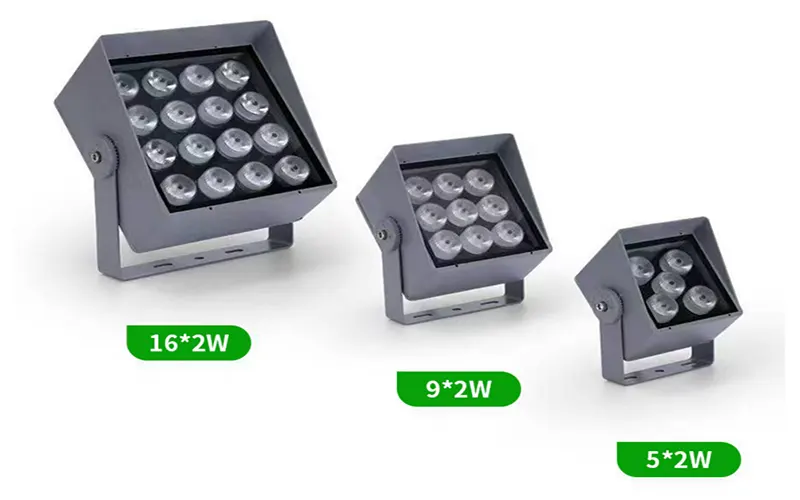
- LED floodlights: Use light-emitting diodes (LEDs) as the light source, representing a new generation of high-efficiency lighting solutions.
LED Floodlights VS. Halogen Floodlights
LED floodlights and halogen floodlights utilize completely different light-emitting principles, and these differences directly affect their performance and usage characteristics.
LED Floodlight Working Principle
LED floodlights operate based on the principle of semiconductor light emission. They utilize semiconductor chips that emit light directly under the action of electric current, resulting in high luminous efficiency. The LED chip itself only emits monochromatic light, which is then converted into white light or other colors through a phosphor coating. LED floodlights typically use multiple LED chips combined with optical lenses or reflectors to achieve a wide-angle light distribution.
This method of light emission has several significant characteristics. First, LEDs are cold light sources, generating relatively little heat during operation, which means higher luminous efficiency and lower energy consumption. Second, LEDs have an extremely fast response time, reaching full brightness instantly without requiring a warm-up period. Third, the LED spectrum can be precisely controlled through the selection of chip materials and phosphors, providing optimized spectral distribution for different applications.
Halogen Floodlight Working Principle
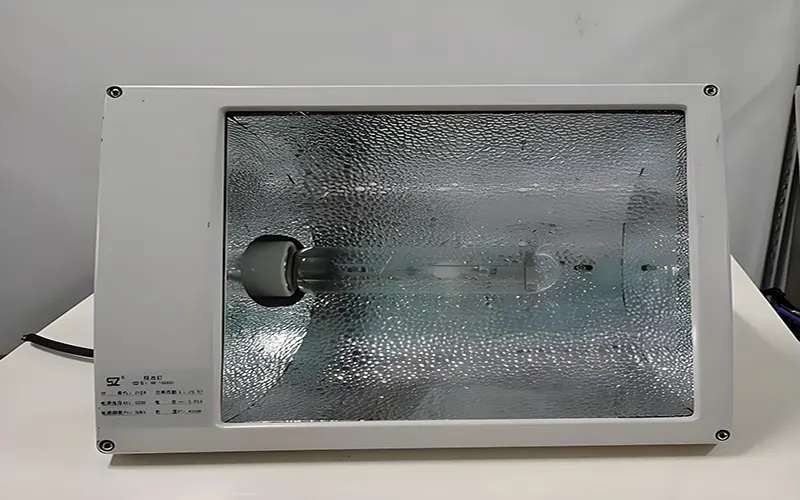
Halogen floodlights are based on the traditional incandescent lighting principle. At its core, it utilizes an electric current passing through a tungsten filament to generate heat and light. The bulb is filled with a halogen gas to extend the filament’s lifespan. When current passes through the tungsten filament, it is heated to a high temperature of approximately 3000K, at which point it begins to emit white light. The halogen gas combines with the evaporated tungsten atoms to form tungsten halide compounds, which then decompose at high temperatures, redepositing the tungsten atoms back onto the filament. This cyclical process extends the filament’s lifespan.
Because it uses thermal radiation to produce light, halogen lamps provide a continuous spectrum, resulting in excellent color rendering and warm light. However, a significant amount of electrical energy is converted into heat rather than light, leading to relatively low luminous efficiency. Additionally, halogen lamps require a certain warm-up time to reach optimal brightness and are sensitive to voltage fluctuations.
Which is More Energy-Efficient and Cost-Effective?
From an energy consumption perspective, LED floodlights have an overwhelming advantage. The luminous efficacy of LEDs is typically between 100-150 lumens/watt, while that of halogen floodlights is only 15-25 lumens/watt. This means that to produce the same brightness, LED floodlights consume only 1/5 to 1/7 of the electricity of halogen floodlights. For example, for a lighting requirement of 1000 lumens, an LED floodlight only needs 7-10 watts of power, while a halogen floodlight requires 40-70 watts.
This difference is even more pronounced when calculating electricity costs. Assuming 8 hours of daily use and an electricity price of $0.6 per kilowatt-hour, a 50-watt halogen floodlight would cost approximately $88 per year in electricity, while an 8-watt LED floodlight providing the same brightness would only cost $14 per year, saving $74 in electricity costs. For large-scale applications, such as installing 100 floodlights in a commercial parking lot, the annual electricity savings alone would be $7400.
However, in terms of initial purchase cost, halogen floodlights do have a price advantage. Generally, halogen floodlights of comparable brightness cost between $10 and $30, while LED floodlights typically cost between $30 and $80.
However, when considering the total life cycle cost, the advantages of LED floodlights become very clear. In addition to lower electricity costs, LED floodlights have a lifespan 10-20 times longer than halogen floodlights. This means that during the lifespan of an LED floodlight, a halogen floodlight would need to be replaced 10-20 times. Considering replacement costs, labor costs, and downtime losses, the total cost of ownership for LED floodlights is often 30-50% lower than that of halogen floodlights.
Brightness and Light Quality: Which Type of Light is Best for Your Needs?
Brightness depends not only on wattage but also on luminous efficiency and light quality.
LED Floodlight Advantages:
- Higher luminous efficiency: More light produced with less wattage.
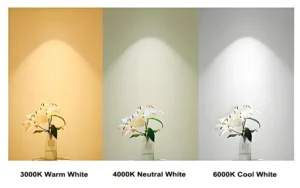
- Selectable color temperature: Offers various color temperature options, including warm white (2700K), neutral white (4000K), and cool white (6000K).
- Higher color rendering index (CRI > 80): More accurate color reproduction.
Halogen Lamp Characteristics:
- Warm light color (approximately 2700K), suitable for creating a warm atmosphere.
- Excellent color rendering index (CRI above 95), but high heat radiation, not suitable for enclosed spaces or close-range use.
Lifespan: Replacement Frequency and Maintenance Costs
LED floodlights typically have a lifespan of 25,000 to 50,000 hours, with high-quality products even reaching over 70,000 hours. This means that if used for 8 hours a day, an LED floodlight can last for 8-17 years. This exceptionally long lifespan is mainly due to the solid-state light-emitting characteristics of LEDs, eliminating the risk of filament burnout, and resulting in a relatively slow and stable light decay process.
In contrast, halogen floodlights typically have a lifespan of only 2,000 to 4,000 hours. Although the halogen cycle extends the life of the tungsten filament, it does not fundamentally solve the problem of tungsten filament evaporation and breakage. Under the same usage conditions, halogen floodlights may need to be replaced every 6 months to 1 year. This frequent replacement not only increases equipment costs but also leads to significant maintenance work.
The long lifespan of LED floodlights also brings other benefits. Firstly, it reduces maintenance frequency, which is particularly important for luminaires installed in high or hard-to-reach locations. Secondly, it improves system reliability and reduces safety hazards caused by luminaire failures. Thirdly, it lowers inventory management costs, eliminating the need to stock a large number of spare bulbs.
Conclusion
The comparison above shows that LED floodlights far surpass traditional halogen floodlights in terms of energy efficiency, brightness performance, lifespan, and maintenance costs. Although the initial investment is slightly higher, they offer significant savings on electricity and replacement costs in the long run, making them particularly suitable for long-term outdoor or industrial lighting applications.
Looking for a high-brightness, energy-efficient, and durable lighting solution? Shop our LED floodlight series now! We offer a variety of wattages and color temperatures. For more questions about choosing the right lighting solution, please feel free to consult our professional lighting consultants!
FAQs
Are LED floodlights brighter than halogen lights?
Yes, LED floodlights are generally much brighter than halogen lights of the same wattage. LEDs have a luminous efficiency of over 100 lumens per watt, while halogen lamps typically only have 10-20 lumens per watt. Therefore, LEDs provide a stronger lighting effect at the same power consumption.
Why are LED floodlights more energy-efficient?
LEDs utilize semiconductors to emit light directly, resulting in extremely high energy efficiency. Most of the electrical energy is converted into light, while in halogen lamps, a large portion of the energy is wasted as heat. Compared to halogen lamps, LED floodlights can save 70% to 90% of electricity, significantly reducing electricity costs.
Are LED floodlights prone to breaking?
High-quality LED floodlights are very durable and have a lifespan of 25,000 to 50,000 hours.
Which is better for outdoor use: halogen lamps or LED lights?
LED floodlights are better suited for outdoor use. They are more durable, have a higher waterproof rating, and are less susceptible to damage from high temperatures, rain, or sand. In contrast, halogen lamps are prone to overheating or water ingress, posing safety hazards.
Can LED floodlights be used in low-temperature environments during winter?
Yes, they can. High-quality LED floodlights can operate normally in temperatures ranging from -40℃ to 50℃.