In modern architecture and urban landscape design, bridges have long surpassed their purely functional role in transportation, becoming important landmarks that showcase a city’s image, technological prowess, and aesthetic taste. Excellent bridge lighting design not only ensures safety at night but also enhances the commercial value of the area and fosters a sense of public pride.
This article will provide an in-depth analysis of bridge lighting design concepts applicable to modern architectural projects, from both practical and artistic perspectives, helping lighting project engineers and designers create stunning and durable illuminated landmarks.
Table of Contents
1、Using Linear LEDs to Create Bridge Contour Lighting
This is the most classic and efficient design approach. By precisely embedding or attaching high-brightness, low-energy linear LED luminaires to the edges, railings, and structural contours of the bridge, the overall form and structural lines of the bridge are clearly outlined.
This solution is particularly suitable for modern bridges with elegant structures and clean lines, achieving the clearest visual identification effect with minimal light. The key is that the luminaires must be installed discreetly so as not to detract from the architectural beauty of the bridge during the daytime.
2、Zoned Lighting Design Enhances the Three-Dimensionality of Bridges
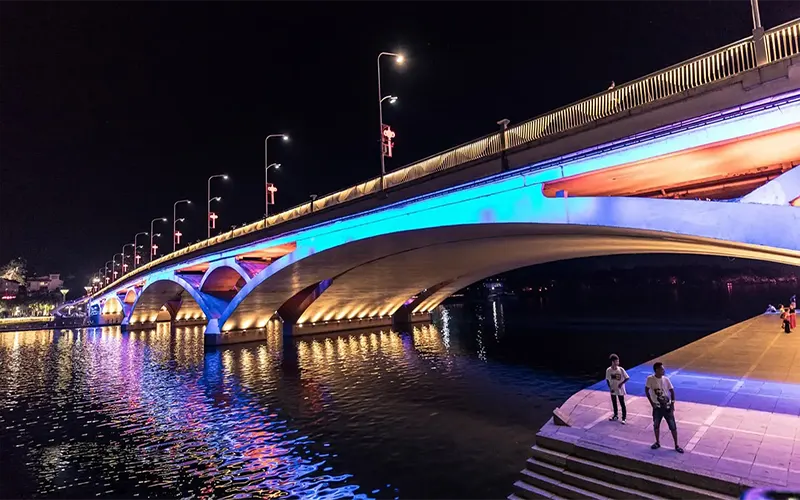
For large bridges with complex structures, a single outline lighting scheme may appear flat. By employing zoned lighting, and applying contrasting light and shadow effects to different structural levels (such as the main bridge deck, lower pedestrian walkways, and supporting trusses), the three-dimensional and volumetric aspects of the bridge can be greatly enhanced. By controlling the light intensity and color in different areas, the visual hierarchy of the bridge can be reshaped at night.
3、Utilizing Dynamic Programmable Lighting
In projects where conditions permit, dynamic programmable lighting can significantly enhance the visual appeal of bridges.
Through DMX or other intelligent control systems, lighting effects such as gradients, flowing patterns, and scene changes can be achieved. This is not only suitable for creating a festive atmosphere during celebrations but also allows for daily “scenario mode” management (such as weekday mode, weekend mode, and late-night energy-saving mode), making bridge lighting synchronized with the city’s rhythm and transforming it into an intelligent, responsive public art installation.
It is important to note that dynamic lighting should serve the city’s image and the nature of the public space, avoiding excessive entertainment. Reasonable control of dynamic frequency and brightness is crucial to achieving a balance between aesthetics and practicality.
4、Energy-Efficient and Sustainable Bridge Lighting Solutions
Sustainability is a cornerstone of modern engineering. The core of energy-efficient bridge lighting lies in: selecting high-efficiency LED light sources, equipping intelligent dimming systems (automatically reducing brightness based on time and traffic flow), and prioritizing the use of renewable energy sources such as solar power for partial or complete power supply.
From a long-term operational perspective, energy-efficient lighting not only reduces electricity costs but also better aligns with government and public project requirements for sustainable development.
5、Accent Lighting Design for Bridge Piers and Columns
Bridge piers and columns are symbols of strength, yet they are often overlooked. Using high-power floodlights for accent lighting on these structures visually reinforces the stability and strength of the bridge. Especially for bridges spanning water, carefully calculated lighting angles can create magnificent light column reflections on the water’s surface, doubling the visual impact. During design, it’s crucial to control glare to avoid interfering with navigation or driver visibility.
Typically, floodlights or wall washers are used to illuminate the surface texture of the bridge piers from below, making the structure appear clearer and more substantial at night. This type of design is particularly common in large river bridges or major urban bridges.
6、Using Different Colored Lights to Create a Festive Atmosphere
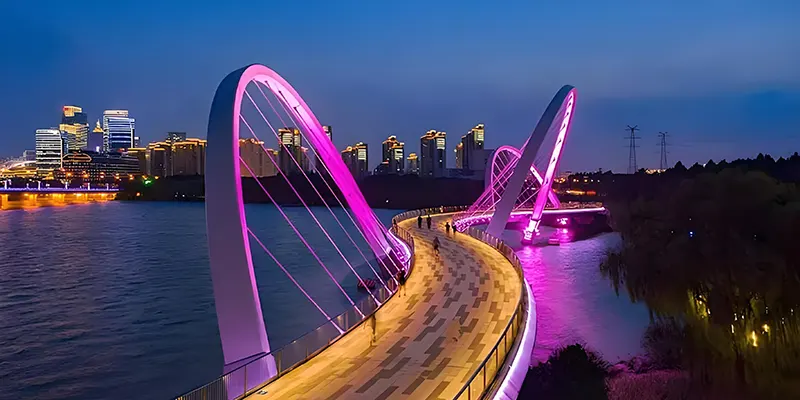
Color is the most direct tool for conveying emotions. During major holidays, city celebrations, or specific public awareness days, changing the overall or partial color of the bridge lighting can instantly activate urban emotions and attract public attention.
For example, during holidays and city celebrations, RGB or RGBW lighting fixtures can be used to quickly switch between thematic colors.
For municipal projects, this “multi-purpose” lighting solution significantly enhances the value of the bridge lighting system.
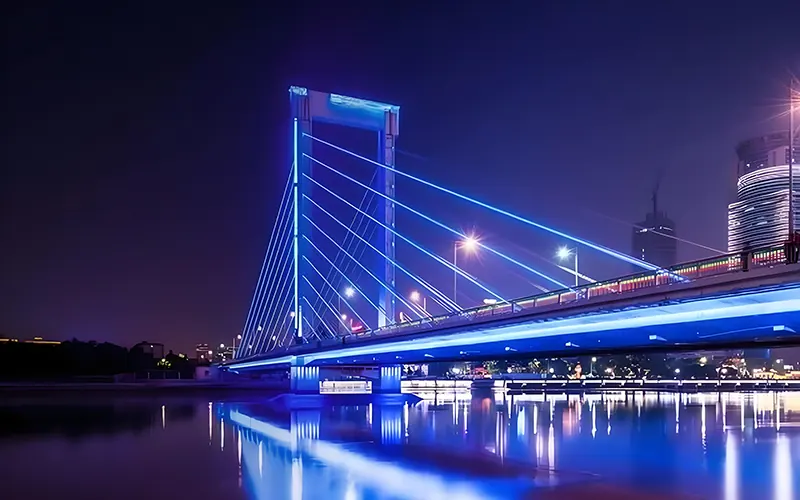
7、Collaborative Design of Water Surface Reflection and Reflection Effects
For bridges spanning rivers and lakes, water surface reflection is an indispensable element in nighttime landscape design.
By carefully controlling the angle and brightness of the lighting fixtures, clear and soft reflection effects can be created on the water surface, further amplifying the visual impact of the bridge’s nighttime scenery.
A calm water surface can create a perfect symmetrical mirror image, while rippling waves can scatter the light into shimmering reflections, creating a dreamlike effect. The key lies in collaboration with the water environment, not simply illuminating it.
8、Protection Rating and Weather Resistance of Bridge Lighting Fixtures
Bridge environments are harsh, facing multiple challenges such as vibration, temperature fluctuations, rain, and salt spray (in coastal areas). Therefore, the protection rating (IP rating) and corrosion resistance of the lighting fixtures are crucial. Bridge lighting fixtures are exposed to the outdoor environment for extended periods and must possess excellent protective performance.
Common requirements include an IP65 or higher protection rating, as well as corrosion resistance, vibration resistance, and UV resistance.
9、Modular and Maintainable Bridge Lighting Design
For large bridge projects, the long-term maintenance costs often exceed the initial installation costs.Modular luminaire design can significantly reduce maintenance difficulties, allowing for localized repairs without requiring complete replacement.
This means that luminaires should be easy to disassemble and replace, and easily damaged components such as power supplies should be located in easily accessible areas (such as within the bridge’s maintenance access tunnels).
Using luminaires with uniform specifications and standard interfaces can significantly reduce the difficulty and cost of future maintenance and inventory management. Good maintainability design directly determines the cost and performance of the lighting system throughout its entire lifecycle.
10、Carefully Reducing Light Pollution
Bridge lighting should balance visual effects with environmental impact. Excessive brightness, stray light, or inappropriate illumination angles can affect surrounding residents, traffic safety, and the ecological environment.
By using cut-off luminaires, precise optical components, and carefully controlling brightness and beam angles, light pollution problems can be effectively reduced.
Summary
By effectively utilizing linear lighting, zone design, intelligent control, and high-quality luminaires, bridges can not only meet basic lighting needs but also become an important landmark in the city’s nightscape.
Please contact us to receive a customized lighting design plan and technical consultation tailored to your project’s specific characteristics, and let’s work together to create the next iconic bridge.
FAQs
What are the most commonly used lighting fixtures in bridge lighting projects?
Common bridge lighting fixtures include linear LED lights, wall washers, floodlights, and point source lights. Different fixtures are suitable for different structural parts of the bridge, such as the bridge’s side profile, bridge piers, or cable structures, and are usually used in combination to achieve optimal results.
What are the biggest challenges in upgrading the lighting systems of old bridges?
The main challenges lie in avoiding damage to the original architectural structure and working within the limitations of the existing power distribution system. We typically recommend using lightweight, modular wireless control systems to minimize drilling and damage to the bridge structure during wiring.
Is dynamic lighting a requirement for bridge lighting?
Dynamic lighting is not mandatory for all bridge projects. It is more suitable for landmark or iconic bridges that contribute to a city’s image, while ordinary traffic bridges typically use static, stable lighting. The decision to use dynamic lighting should be based on a comprehensive assessment of the project’s purpose, budget, and local regulations.
Are bridge lighting systems expensive to maintain?
The maintenance costs of bridge lighting systems can be significantly reduced by using modular luminaires and a well-designed wiring scheme during the design phase. Modular design allows for localized replacement, avoiding the need for complete dismantling, which is beneficial for long-term operation and management.
How to choose the right bridge lighting supplier for your project?
For bridge lighting projects, it is recommended to choose a supplier with project experience, stable product quality, and strong technical support capabilities. Lummilight can provide recommendations on lighting fixture selection, control system solutions, and after-sales support, which will contribute to the smooth implementation of your project.